

Eating & Being Eaten: Meaning in the Age of Excess
- 4 days ago
- 25 min read
On the Things We Keep and the Stories We Tell About Ourselves

In this hybrid visual-literary meditation, Photojournalism Fellow Mackenzie Miller examines the meanings we assign to objects in an age of capitalist excess, partisan identity, and spiritual scarcity. Through Eula Biss, family photographs, and a deeply personal encounter with her grandmother’s dementia, Miller considers how possessions can both obscure and illuminate what we value most.
I have moved five times in five months, relinquishing the weight of my belongings with every departure. Every move brings a sharper awareness of what is actually required to keep my physical body intact (not much), alongside a growing urge to decipher what actually “matters” to me. And with every migration, I surprise myself. My unwillingness to let go of certain objects that have no “use” sans memoria initially seemed nonsensical considering my general predisposition to transience, and distaste for capitalism. I am no nomad, though. So, in the twenty-something style of having an existential question-the-meaning of everything crisis, I obsessed over asking myself why certain possessions felt charged with purpose, why others felt excessive, and why I was so quick to draw a moral line between the two. I flirted with the classics at first—Marxian commodity fetishism, Heideggerian being, Buddhist non-attachment, attachment theory, even YouTube videos of extreme minimalists and ascetic monks. Particularly, I wanted to understand the illusion of stability our things seem to offer us. My mind spun George Carlin’s Stuff on an obsessive loop as I encountered an assortment of unexpected transitions, hoping that if I could not rid myself of material clutter entirely, then maybe there was an opportunity to rid myself of the mental kind. If the goal is to feel free—as free as one can within the context of an accelerating climate crisis, political polarization, global backlash against women’s rights, and perverse economic inequality—then one should, in theory, be able to pack what they need in at least a singular suitcase. That was my goal, at least.
Naturally, in December’s austerity—while tasked by the Parlor to construct a visual essay on objects of memory—I subjugated myself to further immersion into my psychological preoccupations with cognitive and material clutter. Between apartments and jobs, I was failing to see the light at the end of the tunnel. What better way to lift the spirits than by purchasing a little treat! I deigned to obtain a physical copy of Having and Being Had by cultural critic and educator Eula Biss despite a storage unit of unread books, and read it in between unpacking, sorting, hauling, and repacking. Further complicated by the whirlwind of consumption and anxiety that is the holiday season, I engorged myself both mentally and physically with her words: the weight of stuff, a seemingly inevitable accumulation of what we are told to value and the uneasy awareness of our finitude. I blame my intellectual masochism on the cold and the damp, as well as my inclination to work myself into a frenzy trying to get my loved ones the absolute perfect gift: one so representative and thoughtful that ideally, they are moved to tears. Even more reason to ponder objects, read theory, and ask “Why?”.
In her book, Biss writes that "having" has become a substitute for "being"—that we have accumulated objects as evidence of who we are rather than allowing ourselves to simply exist. She describes the work as “an experiment in refusing the givens of the middle class” (288). Organized into brief sections named for economic concepts, her book interrogates terms through which capitalism has naturalized: consumption, work, investment, etc. She underscores that accumulation acts as a shorthand for identity. A sort of possession as assertion. I immediately agreed with her. Yes, I thought, this is what I have been waiting for: someone to finally praise my self-righteous disgust for an increasing reliance on creature comforts while also scolding me (us) for pretending that we have no control in the system that perpetuates it. She directly relates to the middle-class American, in that there is a hatred of both the system and the self for the ease of participation in our inheritance of surfeit as we accumulate more to prove to the world who we are. However, as many cultural critics do, she seems unable to enjoy most of the belongings she has - including her first mortgaged home.
This is the central tension to her musings, yet, I think perhaps where we may find our domestic salvation. In order to grapple with our involvement with excess, we must ask ourselves: if our consumer-centric society relies on our reliance on our objects, how are we supposed to maintain a self-loving (and neighbor-loving) outlook when we cannot seem to abstain from material accumulation? How are we not to judge ourselves and others for what they cherish materially when our consumption values and practices often signal partisan ones? According to centuries of spiritual doctrine, we are meant to practice compassion for all and detach from earthly concerns. Hard to do with two fully stocked storage units, an extended family that can barely share a meal without a political cat fight, a general malaise about the state of society, and the fact that I rarely tried to define my own attachments to certain objects.
These questions burn—precisely because consumption patterns often function as a visible proxy of ideological identities and partisan divides. We anchor our sense of self in the identities we inherit and the material values we display, clinging to them as if they were the only proof of our existence and the main source of our comfort. What we choose to use, buy, wear, eat - all of these items signal internal value that increasingly map onto partisan divides. However, Biss doesn’t outright address the elephant in the room: that while we may chastise ourselves (and others equally complicit) for participation in this economy of identity, we are bombarded daily with news of powerful political actors actively profiting from, mobilizing, and exploiting the same participatory attachment and accumulation without the same self-scrutiny.
Gospel of Excess: When Christian Identity Meets Consumer Power
79% of Donald Trump’s voters identify as Christian. This came as no surprise to me. Many of my extended family members are included in this statistic. Republican elites and conservative coalitions have for years mobilized faith and material (or economic) identity together. Many of these voters, like my grandparents, voted for Trump primarily because of their faith based moral concerns. Often, these concerns are intertwined with partisan and economic ones. The courting of a religious base to support a political party is not exclusive to the modern age—it is a practice that has taken place for centuries. However, what feels distinct in this cultural moment is the degree to which belief is materialized: worn, purchased, and staged. If, as Biss argues, we accumulate objects as evidence of who we are, then political faith too must determine the importance of our artifacts.
Christians, by instruction of the Gospel and Jesus himself, are not meant to pursue wealth or material excess. Rather, they are instructed: “[do] not store up for yourselves treasures on earth…but store up treasures in heaven” (Matthew 6:19-20). In Luke, Jesus warns to “beware of covetousness, for a man’s life consisteth not in the abundance of things which he possesseth" (Luke 12:15). Yet Trump’s own public persona has always been architected through accumulation. Long before politics, his brand depended on the shocking display of opulent material spectacle: gold-plated interiors at Trump Tower, his surname affixed in massive letters to buildings across the globe, his Mar-A-Lago club, a private Boeing 757 customized with his name in twenty-foot lettering and 24-karat gold seatbelt buckles. Over the decades, the Trump Organization licensed his name to more than 20,000 consumer products worldwide: $1,000 steaks, vodka, “Never Surrender” sneakers, mattresses, cologne, urine test kits, to name a few.
In the recent Republican coalition, white evangelical voters. White evangelicals, a group explicitly organized around a religious identity that instructs believers to resist material excess, were heavily courted as a political base. At the same time, America’s economic and cultural structures were increasingly normalizing commodified faith and affluence-driven surplus. Donald Trump and his self-appointed disciples have turned religious attachment into capital.
They have profited from branded merchandise like Trump-themed sneakers, watches, fragrances, and, most notably, Lee Greenwood’s God Bless the USA Bible, which alone generated more than $1.3 million alone in royalty income for Mr. President, according to federal disclosure forms. In fact, he advertised the Bible on his campaign trail in 2024 to “make America pray again”. I felt like banging my head against a wall (or perhaps through it), because there couldn’t possibly be a way to justify such ecclesiastical profiteering after reading Luke 12:15. Or Matthew 6:19-20. Or the whole damn book. It is so striking (and profoundly satirical) that a politician touting Christian values has so aggressively commercialized and individually raked in millions off of symbols of faith and allegiance-based junk. It is enough to make me wonder if he has actually read the Bible he endorsed.
The irony continues as I read about wealthy conservative insiders flying across the country in private jets on a whim, burning millions of gallons of fuel and giving themselves yearly pay-outs to do so. But I digress. Except I don’t. I can’t stop thinking about how I have family members who would defend this behavior, yet scoff when I say that I don’t go to church every Sunday. As I move from place to place, hoping to find solace in my accumulation of belongings, I rage against that which I cannot control. Like how a recent Republican-backed tax provision allows luxury jets to be written off immediately, and has been criticized for subsidizing private aircraft ownership for the wealthy at the expense of social welfare and environmental programs,—a display far removed from biblical admonitions about humility and restraint. These headlines must leave true believers, such as my grandparents, at home navigating some sort of anxiety between the promises of their possessions and what they actually provide, right? Or is that just idle fantasy. But I have a sneaking suspicion that Jesus probably wouldn’t have arranged to accept a custom-built $400 million Boeing 747-8 “flying palace” luxury jet from the government of Qatar. But who am I to say? I don’t go to church and I just bought a new pair of jeans off of Depop because the discount felt too good to pass up. I’m not sure they’re even that cute.
The lifestyles that we are told to feel ashamed of—and the objects associated with them—are often the very ones political power depends on us continuing to desire. The 1% (both politically and economically) cannot wield and abuse their power without us buying bullshit, literally and figuratively. Trump merchandise is designed not to last, but to circulate—cheap, disposable, and destined for the dump—yet it is sold as permanence, heritage, faith, belonging. I continuously ask myself what would happen if we just stopped? What if we really asked ourselves what we would buy, keep, and gift if we only engaged with things that truly mattered to us?
Thankfully, as a society, we still know how to call misaligned behavior and class-domination out when we see it: thank you FlightAware and Tik Tok user @niklasVR. At least, you could say, we are aware. At least, I am better than them and their fanatics, I say as I flip through Biss’ writings and take another bin of junk to Goodwill. Nevertheless, tracking Donald Trump’s consumption patterns does nothing positive for me (or really, for anyone). As a moderate realist, I must call attention to the fact that as it stands, no amount of resentment towards the consumption habits of political elites changes the fact that we all continue to buy, use, and perhaps find solace in accumulating stuff.
Consumer Identity, Class Anxiety, and the Politics of Attachment
It is true that we are embedded in a consumer-capitalist technocracy, one that often feels pulled from a Black Mirror episode. It increasingly pressures us to outsource our competencies and construct our social identities through material things. There are even studies suggesting that higher socioeconomic status can predict increased unethical behavior. Accepting that possibility produces a particular kind of despair: if I keep acquiring more, as I am told to want and often do, who might I become? I should aim to have less— but how? I don’t even want to be playing this game, as Biss eludes in her writing. But if we have to play, wouldn’t it be easier not to think about whether what we deem “necessary” was ever really our idea to begin with? Now I am getting far too ahead of myself into notions of free will. Let me backtrack for a moment.
Biss grapples with the notion that her socioeconomic status has changed dramatically after her raise in pay and purchase of a home and writes, “Now I’m pulling weeds in the garden of an elementary school, wondering if I’m on my way to becoming an asshole” (45). Telling yourself you are going to become an “asshole” while also being sold the idea that more something is always better doesn’t really seem fair. She writes, “What’s to blame is the comfort the higher class status affords—the independence, the insularity, the security, the illusion of not needing other people” (46). We are told by mass media to love comfort, abundance, and things—but human beings loved and assigned meaning to objects long before advertisements ever existed. From shell beads crafted and worn purely for adornment almost 150,000 years ago, to the hand-painted dolls of recent antiquity, to heirlooms—we have always attached meaning to matter. Why would the trinkets of late-stage capitalism be any different? Our attachments to objects have deeper roots; they are not simply a matter of partisan signaling or public identity.
When I stumble across works like “Material World” by Peter Menzel, I realize that not everyone on our good green earth accumulates and identifies with their belongings in the same ways. The relationship between identity and possession is not fixed; what feels necessary in one political and economic context might look excessive in another. One man’s trash may really be another man’s treasure. In 2011, The Wall Street Journal reported that Americans spend $1.2 trillion annually on nonessential goods. Obviously, that statistic is outdated, and spending has likely declined somewhat since then due to rising economic anxiety. But even if conspicuous spending had fallen to a fraction of that amount, I would still ask: why?
Based on everything Biss (and I) have been talking about, it is quite clear that we buy out of fear, allegiance to identity, exhaustion, and the fact that it doesn’t feel like we can opt out. It is clear that accumulation is uneven in this world, but attachment is universal; the meaning behind these attachments, shifts however. Biss stops short of staging a direct indictment of religious spectacle, but I couldn't help myself. I think it is profoundly difficult to do what she does—turn the lens inward on her own participation rather than fixating on the theatrical excess of the uber-wealthy. Neither is easy on the psyche—I would know—but by asking us to question our positionings within capitalist frameworks, Biss saved me from falling down a rabbit hole of performative algorithm-fueled outrage.
My desire lies in understanding the common thread behind what we feel that we need and what we choose to keep. Could there be a way to live more harmoniously—or at least symbiotically—with ourselves, our perceived “others,” and our objects in this seventh circle of capitalist hell? Is it possible if we associate who we are with what we own? I believe that it is possible to positively identify what we value materially—our real treasures—removed from what we are told we need by billionaire tech evangelists and felon-politicians. That does not change how difficult it is to ask myself such questions. It would be far easier to ask them of everyone else first.
All this is to say that making myself feral on a diet of headlines had done me no good, especially two weeks before Christmas. So I took her book and got out of dodge. I escaped to my hometown woodlands of Bend, Oregon to house-sit for my conservative grandparents, read the antithesis of Eula Biss’s work, The Secret Life of Objects by Dawn Raffel, and hopefully touch some grass. Once again, I obtained a physical copy of said book; however this one was a gift, so I will gracefully omit it from my list of consumption casualties. Raffel’s book centers on the positives of what we choose to keep over time—how we attach memory to objects consciously and subconsciously. Each chapter (as short as a half-page) describes the memory behind one of her possessions. As it neared closer and closer to the holidays, I desperately needed some relief from the oppressive political polarization bombarding my feed and familial sphere. Plus, it was too serendipitous to be given something like that and not bring it with me. Coincidentally, my Instagram algorithm continued its sermon and hand fed me post upon post of artistic interpretations of everything I had been pondering: understanding others through their material consumption, what that means within a consumption-driven society, as well as the innate connection of humankind to our belongings. Sometimes living in a near Orwellian surveillance state does have its perks.
One piece that particularly struck me was Song Dong’s 2009 installation Waste Not. The artist lays out an overwhelming display of all of the objects his mother accumulated—and importantly, chose to keep—over a lifetime. An estate sale in a gallery, perhaps. The work does not mock her accumulation, rather it dignifies it by emphasizing that fear of scarcity, cultural norms, and belonging produce their own logic of keeping. Each object seems to be relational and carry memories that are interwoven with one another, yet the excess is visually overwhelming. In this way, the installation suggests that accumulation is not purely about attachment to identity or to limiting beliefs, but about attachment in all its forms. We die surrounded not merely by things, but by the physical traces of our lives. Scrolling through photographs of Waste Not where everything is arranged, it is clear that to the muse of the piece, everything was once usefu—everything seemed once necessary—but most importantly it seems that everything was kept to remember. Objects are never neutral; they are saturated within the context of our external world, but also the internal one.
Another example is an art-school classic: every art student I know (willingly or unwillingly) studies Marcel Duchamp’s Fountain. A urinal turned on its side, Fountain is utilized by many in art history/ art professors to explain that one thing (like a toilet) can actually be a sculpture and not just a toilet depending on what the artist says it is. Conceptualism. At least that is what I remember from art class. The point is that meaning is assigned (not inherited) in terms of art, and with our objects. Regarding our possessions, it is our choice and context—rather than price tag, status, or market logic—that defines its meaning to us. I studied this only 3 years ago, and yet I am shocked at how often I forget its powerful simplicity. Objects mean what we say that they mean. Worth and meaning, purpose and value is relational, not fixed. In other words, I had realized the system we find ourselves in is an Ourobus. We consume garbage (both physically and mentally), thinking there is an end to all the madness and there is not. At least, not one that is easily dealt with or understood. If there is any salvation however, it lies in purifying ourselves by knowing that we come from a fullness—whether we call it God, love, community, or simply interdependence—and remembering that the power to assign meaning does not belong solely to markets, politicians, or advertisers. It belongs, at least in part, to us.
I felt the need to reconcile these revelations somehow. We have the power to define what our objects mean to us—we don’t have to let them do it for us—and perhaps the most powerful meaning they carry is the one attached to memory. The indelible link that connects us to each other and the lifeblood of our lives.
The Politics of Fear, The Practice of Love
Truthfully, I did not begin to think about possessions and their meaning solely because I had to move five times in five months, or because of politicians and economic inequality, or even because of Eula Biss’s book. I began thinking about it because of her.
My maternal grandmother has dementia. Physical decline always makes one think about death, and with death comes thinking of faith, but it also forces a reckoning with what has been kept over a lifetime. Oftentimes, as someone who has always preferred buying secondhand, I like to look through the discarded belongings of the deceased at estate sales—searching for objects that I may come to possess as my own. I can’t help but wonder what, if anything, they would have liked to carry with them on their journey to the pearly gates. Ideally nothing, if you are going by the Big Book, but it’s clear there might be some loop holes there. Because of her faith and the reality of aging, the same applies when I think of my grandmother. And, after all this theorization and contemplation, I started to think that maybe she could show me if I was right. If she could show me who she was through her possessions, rather than letting them define my perception of her.
So, I picked up my camera and got to work, cataloging what I thought represented who she was.
I am a photographer because I am a historian. Every photographer is a record-keeper whether they understand it or not. We are observers and preservers by nature. So, what better way to catalog my grandmother’s memory than to understand her faith, her political party, and her attachment to those identities further through objects. Objects were taking up all of my time anyways, and I am not naive enough to ignore the possibility that if I wait too long to ask her, she might not remember her own answers. So I asked my grandmother what she considered her most prized possessions. I asked not only because I fear she is losing more of her memory, but because I had begun to feel I knew less and less about who she was beneath her growing identification with the political right and the faith-based commitments that accompanied it. I consciously choose to avoid arguing about facts or figures with her at this point—what would be the use? She might not remember the explanation. And even if she did, I know the majority of her convictions have grown over time from a habitual consumption of propaganda meant to separate us from one another. So I let it go. But, like the rest of us, I am not immune to making assumptions about what I can’t understand.
When I picked up my camera to photograph what she had brought for me, I realized I had been hoping, subconsciously, that she would show me something that would confirm my biases towards elderly conservatives. I had made assumption upon assumption regarding what she valued based on that which she defended politically. Sue me. She watches Fox News daily (so much so that I blocked the channel on my own television), worries aloud about immigrants, about socialism, about people “bringing pronouns to Bend”, and about people coming to take what's “rightfully hers”. Her politics are largely organized around property rights, ownership, around an imagined siege on proper American values. So I imagined she would show me the deed to her house, or maybe family heirlooms that could bring in some cash, or maybe one of her many diamond rings. I was already brainstorming the ways I could make a visual commentary supporting exactly what I knew everyone would want to hear and think based on what is happening to our country: that the far right don’t really care about people, they care about themselves and they care about money.
She placed in front of me only photographs and a few other memorabilia. There were no objects that had any material value, save to maybe someone who really liked picture frames. Included were a newspaper clipping from her years as a dance teacher. The pamphlet from her best friend's funeral. The rest, framed images of her immediate family. That was it. I asked if there was anything else, and all I got was a sweet smile and a slight shake of the head. In the cover of Raffel’s book my best friend had given me she wrote, “Saw this book and immediately thought of you. I love how you apply so much sentiment and find so much beauty in the objects of your life. The memories they have inspire me to see stories in everything”. In that moment, I realized two things. One: That maybe being attached to things purely for memories sake wasn’t unique to me and it actually ran deep in this family. Two: that I had incorrectly judged my own grandmother based on politics—assuming I knew what was most important to her—when she had never done the same to me.



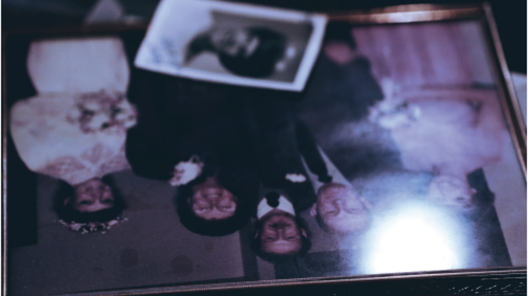

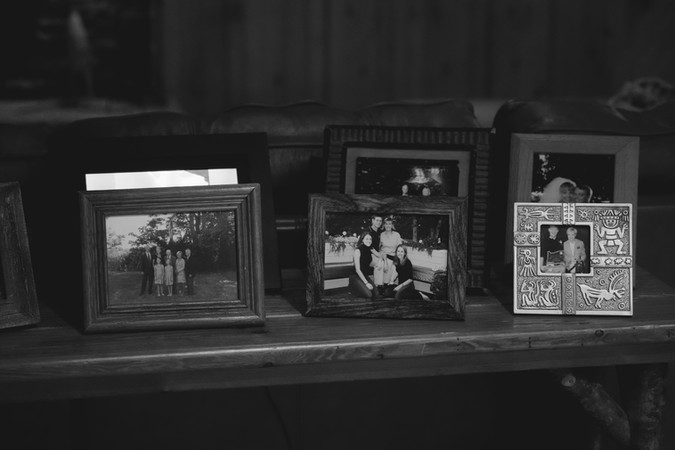


As I looked through her objects of memory, I felt the room slide out from under me, the walls tilting slightly as if the house itself were exhaling a long, tired breath. I had been clinging to a life raft of certainty, believing that I could nearly place people—even people I care about—into boxes of perception and understanding. But why, then, did she seem so keen to preach about protection and the myth of ownership while being so afraid of losing what she believed was “rightfully” hers? The irony of the conservatization of elderly Christian Americans is that many have become indoctrinated into a cult of perpetual scarcity, yet what I found looking through my grandmother’s cherished items—brittle photographs, yellowed newspaper clippings, a trophy made of cheap, golden plastic—indicated that such scarcity is meaningless when you are faced with your inevitable end.
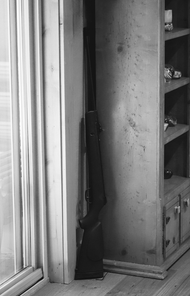
Eula Biss writes about this kind of fear—how it's cultivated and how it's sold right back to us. She notes that Americans spend more on home security systems than most of the world spends on housing itself. We buy alarm systems and guns and Ring doorbells to defend property we probably don't even own yet, protecting things we're still paying off. My grandparents have a loaded rifle sitting next to the screen door at all times. The threat is always vague, always external, always imminent. She bought my grandfather another gun this Christmas, as if one was not enough. This is the language my grandmother uses: They are taking our jobs. They want what is ours. But when pressed on who "they" are or what exactly is at risk, the threat dissolves into vague abstraction. My grandparents moved to La Pine, Oregon after retiring from teaching. They have made the rest of their retirement money—which allows them to spend quite a bit more than the average retiree—from government pensions.
Their home is remote, near the Deschutes River. But it can’t be her house she fears losing—she owns it outright. Not her savings—they're secure. It is something more ideological, and perhaps something that is already lost. It’s the feeling that the country—and the party she identifies with —no longer reflects the Christianity (or freedom) she was taught to cherish. It is the feeling that the best days of her life, and her home, are behind her, and may not return. In every room of her house there is an image of me. Or my twin sister. Or my mother. Her son. My cousin. Her husband. Or some combination of all of us. Observing someone you love, someone you have known your whole life, slipping into the eventual unknowing of themselves is like witnessing a car crash in slow motion. Albeit a little corny, it feels like being in grade school watching the balloon you had tied to your wrist float away. Craning to watch until your neck hurts from the strain. Many times this year, I forget she is forgetting, yet I notice the moment when my reaction to her stories and jokes don’t garner the same reaction as she thought they might. I struggle to respond when the same punchline arrives again and again and again and again, unchanged, minutes apart. I do my best, but even though her mind is failing, she still senses when I am mirroring back her changed self. Beneath a rhetoric of defense and protection is a deeper fear of having lived wrongly, of no longer being counted among the good, of realizing time is running out to be with those you love.
Biss writes that capitalism requires us to believe that what we have is always at risk. This keeps a large majority voting for politicians who (regardless of the truth) promise to protect us and bring the country back to its connection to tradition and divine faith-based morals. This belief keeps us from examining what we actually need, what we actually love, and what we actually would mourn if lost. I believe that my grandmother doesn’t actually give a rat’s ass about Donald Trump (though I do not condone willful ignorance). What she really cares about is keeping things the same—at least for as long as she can reduce her life to the memory of its fondest moments.
This is what I had failed to understand about her, and maybe what Biss fails to understand about the individual: that her politics (her admiration for the system that I despise) and the love that she has (and most generally shares towards her loved ones) operate in completely separate registers. There is a strange relief in realizing there is little chance she will forget me. Maybe, eventually she will. I don't know. But my face is plastered on almost every surface that can hold a 4x6 frame. The photograph she chose of my sister and me was taken on a vacation she took me on when I was 8 years old. When I asked her why she chose that image, she could only say: “I just love it. We had so much fun.” In fact, when I asked her why she chose any of these objects, she could only say: “I don’t know. I just love them.”
Enough, and the Impossibility of More
Biss concludes her book by admitting that she doesn't know what it means to have enough. She has a house, savings, stability—and life still feels precarious. I concluded my trip home with a similar sentiment. I also don’t know what it means to have enough. I don’t know what any of it really means. But I do know why I can’t throw away the horribly-stamped leather bookmark my twin sister made for me at Girl Scout camp in third grade. And the dress from my first high school dance (hideous by the way). Mugs that I used while living with friends in college that sit in the very back of the cabinet. Jewelry that was gifted to me that I wouldn’t wear. We should not be made to feel that these objects, no matter how trivial they may seem to others, do not deserve to take up space in our lives.
From studying international politics and environmental science—and, more intimately, spirituality outside academic frameworks—I have come to feel that the future of humanity depends on our ability to value connection more than possession. To focus on the good rather than lamenting over evil. I say this because the world offers corruption and grace in equal measure—and because if I don’t tell myself this I will want to tear my hair out in psychotic clumps. It is hard to swallow at times, but attention truly is its own form of worship. What we choose to attend to both mentally and physically, is up to us, regardless of what we are told to think and value by those in positions of power. Just as well, it is a choice to decide which objects and purchases we allow to carry meaning and relational significance. Again, it’s hard to digest with boxes of books I only plan to read, a closet full of clothes I haven’t worn in years, and a hesitation to throw out empty candle jars and mismatched socks. But no amount of judgement—of myself or my grandmother—will save either of us from the fragility of our very short and very human lives. Nor will any amount of surveillance, guns, or control.
My assumptions were wrong, but that does not mean I was completely baseless. Not everyone in the world is like my grandmother. Some people may not care about memory-based objects at all. Some people truly hate other people and commit despicable acts of evil. There are people who don’t believe in anything at all. Some people live like monks. Yet when I asked over fifteen women of all ages and backgrounds in my own life—who I know are none of these things—by asking them to confirm my theory by showing me their most prized possessions too. It always came back to this idea: I had expected class to matter, political affiliation to matter, but we are all much more similar than we think. I assumed conservatives might guard certain symbols more tightly, progressives others. I imagined people organizing themselves around the objects that best reflected their politics. Liberals, by stereotype, might choose things that signal taste, care, or thoughtfulness. You get the picture. Biss does as well. She observes that capitalism trains us to think of ourselves as consumers first, citizens second, people third. We learn to categorize each other by what we buy, what we own, what we can afford. But none of this bore out. What people loved was always particular to their lives and relationships, always unrepeatable. Nothing I was shown meant anything to me—because I am not them. When I ask others about their most prized possessions—and they name a grandmother's ring, a concert ticket stub, a letter from a past-lover, a photograph, a rock from a favorite beach—they are naming things that capitalism has no language for. These objects have no resale value. They cannot be insured for their actual worth. They represent relationships, faith, moments, feelings that cannot be commodified. And yet they are what people love most.
The gap between what we think people care about based on demographics and what they actually name as irreplaceable is vast. And that gap, I began to realize, is where propaganda lives. We organize our public lives around accumulation and defense, even as our private lives are organized around love and loss. And this gap between what we defend and what we love is where I now exist with my grandmother. I cannot argue with her politics. I also can't argue with her love. It’s the most honest thing about her. The photographs on her walls are a more accurate portrait of her values than any political belief she espouses. They tell me what she actually cares about, what she would actually grieve, what she is actually losing. Biss writes: "To be is not to have." My grandmother is disappearing. What will remain when having is taken away? Only being. Only the fact that she was loved and that she loved.
So…who is more accurate? Biss or Raffel? The cultural critic or the creative writer and poet? I have come to realize that it is both. It is always both. Biss’s condition of living under capitalism is that we can never have enough because "enough" is always being redefined as “more”. Raffel’s condition of living under capitalism, while not expressed outright, is that possessions can be beautiful and add immense value to our lives; mainly if they remind us of a moment or memory where our “stuff” was most likely the least important factor. I choose to re-read Raffel’s take often. I do this because it matters how we frame things, what we see, what we pay attention to. It dictates what we buy, what we keep, and if we judge ourselves and others for it. It dictates how we love and how we live.
Talking with my grandmother, I realized it boils down to knowing what matters versus being told by someone else, especially when you know in your bones that it isn’t really what you believe. If she had spent more of her time being present, bathing in gratitude rather than scarcity, she would know she has enough. She has always had more than enough. Yet because she has been taught to fear losing the tangible—to defend her beliefs, the material, to organize her politics protecting her possessions - what actually matters is slipping away. The intangible—her memories, her sense of self—undefended and undefendable.
I re-read Raffel’s take over Biss’ because I don’t want to forget that the sentiment and value behind our possessions can change over a lifetime. The only constant I have found is that when you get down to it, we primarily value those objects that represent a deeper kind of truth. One about ourselves, the most important memories of our lives, and the ways in which we have loved one another. Nietzsche once wrote that meaning is not discovered but created; objects and practices are continually reinterpreted, repurposed, and understood. Even a major nihilist doesn’t think we are beyond constructing our own meaning. Not beyond return. My grandmother is not wrong to want security. I am not wrong to want lightness. We are both trying to defend ourselves from impermanence. But permanence was never an offer. However, what is offered is the choice to give our energy to forces that cannot be commodified, nor taken from us: memory, relationship, presence.
So, maybe next time you embark on a spring cleaning, look through a lens of memory and love rather than purely social or material use. Maybe the next time you judge someone for mindlessly consuming, choose to recognize they are deep in the throes of an immaterial sense of lack - a spiritual crisis even. Fill your home with photographs of your loved ones, and remain vigilant in the knowing that it is not more things we need, but more connection—to true faith, to presence, to radical non-judgement, and to our own individual power.
I think I will always return to that image of me hanging in my grandmother’s living room. It's not the most recent photograph. It's not the most flattering. But it's the one she chose, the one she keeps returning to, the one she says she just loves. Maybe this is all we can know about anyone: what they choose to look at. What they surround themselves with. What they reach for when asked what matters most. Maybe it isn’t, and we can only know one another through shared memory, shared joy, sharing things. Maybe, the most radical act in dealing with neo-feudalism, late-stage capitalism, and even personal grief is to admit that what matters most cannot be bought, sold, defended, or kept. It can only be loved, remembered, and inevitably, lost.


Comments